

Do Infant Walkers Help Babies Learn to Walk? Facts Every Parent Should Know
Watching a baby take their first steps is one of the most exciting moments for any parent. From the first attempts at sitting and crawling to pulling up against furniture and taking those first independent steps, every stage of early movement brings something special. Naturally, parents want to support their little one’s development and help them become confident as they begin exploring the world.
One product that many parents consider during this stage is a baby walker. These products are often marketed as convenient ways to keep babies entertained and encourage movement. However, there is an important question parents should ask before purchasing one: Do infant walkers actually help babies learn to walk?
Despite their popularity, wheeled sit-in baby walkers do not teach babies to walk sooner. In fact, Australian child-health guidance advises against using them because they can create safety hazards and may interfere with opportunities for natural movement development.
Understanding how babies learn to walk, what risks walkers can present and which alternatives are more suitable can help parents make informed decisions.
In this guide, we will explore the facts about infant walkers, explain the relationship between walkers and physical development, and share practical ways to encourage your baby’s natural movement safely.
1. What Are Infant Walkers?
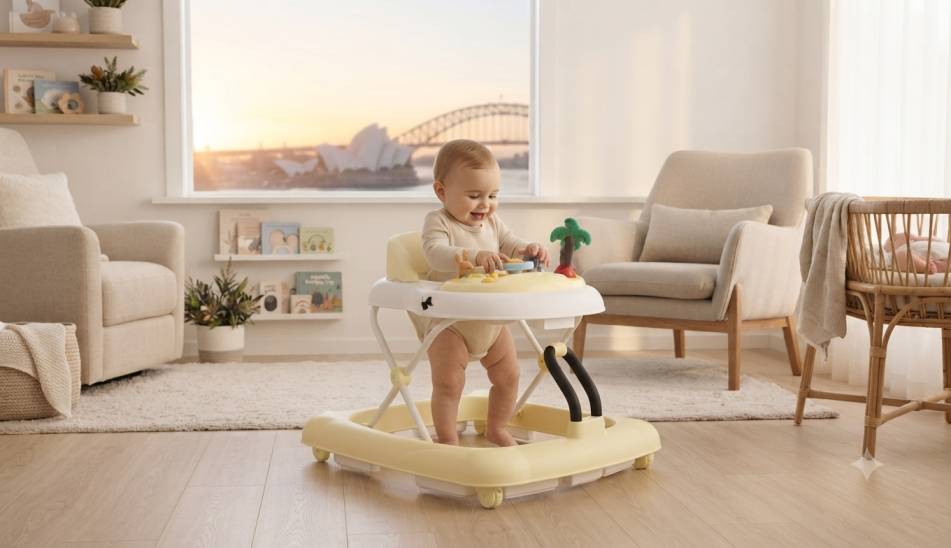
Infant walkers are baby mobility products designed with a wheeled frame and a suspended seat. The baby sits inside the frame with their feet touching the floor and uses their legs to move the walker around.
Most traditional models feature:
- A supportive fabric or padded seat.
- A wide frame with wheels.
- A tray or activity panel with attached toys.
- Adjustable height settings on some models.
- A folding frame for convenient storage.
The main idea behind these products is to allow babies who are not yet walking independently to move around while supported by the seat.
However, this movement is different from learning to walk naturally. When babies walk independently, they must develop balance, coordination, muscle strength and the ability to control their body weight. A wheeled walker supports the baby’s body and allows movement without requiring the same skills.
Different Types of Baby Walking Products
Parents may come across several products described as walkers or walking aids. It is important to understand the differences.
- Sit-in Wheeled Walkers
These are traditional infant walkers with a suspended seat and wheels. Babies sit inside and push against the floor with their feet to move around. These products are not recommended by Australian child-health guidance because of their safety risks.
- Push Walkers
Push walkers are designed for babies who can already stand and take steps with support. They usually have a handle and a stable base that the child pushes while walking behind them. They are different from sit-in walkers, but parents should still choose a stable product and supervise its use.
- Stationary Activity Centres
These products provide a fixed place for babies to play with attached toys. Unlike traditional wheeled walkers, they do not allow babies to move around the room. They should only be used according to their age, developmental and safety instructions.
Understanding these differences is essential because the word “walker” can describe products with very different designs and purposes.
2. Do Infant Walkers Help Babies Learn to Walk?
The simple answer is no. Wheeled infant walkers do not help babies develop independent walking skills or guarantee that they will reach walking milestones sooner.
Learning to walk is a natural developmental process. Babies gradually develop the strength, balance, coordination and confidence needed to stand and move independently.
A traditional walker allows a baby to move around while supported by a seat. However, this does not necessarily help them practise the movements required for independent walking.
For example, a baby learning to walk needs opportunities to:
- Strengthen their legs and core muscles.
- Develop balance while sitting and standing.
- Shift their weight from one foot to another.
- Practise pulling themselves up.
- Learn how to maintain an upright posture.
- Coordinate their movements while taking steps.
A sit-in walker does not provide the same opportunities for practising these skills.
According to Australia’s Pregnancy, Birth and Baby service, baby walkers do not help babies learn to walk and may delay the development of walking skills. They can also expose babies to preventable injuries.
Parents should therefore avoid treating a walker as a shortcut to their baby’s first steps.
3. How Do Babies Naturally Learn to Walk?
Walking does not happen overnight. It develops through several stages as babies gain physical strength, coordination and confidence.
Every child develops at their own pace, so the exact timing of these stages can vary.
Stage 1: Tummy Time and Head Control
During the early months, babies gradually develop the ability to lift and turn their heads while lying on their stomachs.
Supervised tummy time gives babies opportunities to strengthen their neck, shoulder and upper-body muscles. These early movements help prepare them for later physical milestones.
Stage 2: Rolling and Sitting
As babies grow, they begin rolling from one position to another and gradually develop the ability to sit.
Sitting helps babies improve their balance and control their upper body. It also allows them to use their hands to explore toys and interact with their surroundings.
Stage 3: Crawling and Moving Independently
Some babies crawl on their hands and knees, while others use different movement patterns, such as bottom shuffling.
These activities help babies explore their surroundings, coordinate their arms and legs, and develop strength through independent movement.
Not every baby follows exactly the same sequence, and some may move directly towards standing without traditional crawling.
Stage 4: Pulling Up to Stand
Once babies develop enough strength and coordination, they may begin pulling themselves up using furniture or another stable support.
This stage allows them to practise supporting their body weight through their legs and maintaining an upright position.
Stage 5: Cruising Along Furniture
Cruising refers to moving sideways while holding onto furniture or another stable support.
During this stage, babies practise shifting their weight, balancing and coordinating their steps while maintaining support with their hands.
Stage 6: Taking Independent Steps
Eventually, babies may begin standing without support and taking their first independent steps.
According to Pregnancy, Birth and Baby, many babies begin walking sometime between approximately 10 and 18 months. There is no need to rush this milestone.
Giving babies safe opportunities to move, explore and practise naturally is more useful than relying on a wheeled walker.
4. Why Are Infant Walkers Not Recommended?
Although infant walkers may look convenient, they present several concerns for parents.
They Do Not Teach Natural Walking Movements
When a baby sits inside a wheeled walker, the seat supports their body. This means they are not practising independent standing and balance in the same way they would when learning to walk naturally.
Babies need opportunities to control their posture, shift their weight and coordinate their legs. A sit-in walker does not replace these developmental activities.
They Can Reduce Floor Play Opportunities
Floor play gives babies the freedom to roll, reach, crawl, sit and explore.
When babies spend time in a wheeled walker instead, they may have fewer opportunities to practise these important movements.
Regular supervised floor play allows babies to discover their abilities at their own pace.
They May Affect Walking Development
Australian child-health guidance warns that baby walkers do not help babies walk earlier and may delay the development of walking skills.
The concern is not that every baby who uses a walker will experience developmental difficulties. Rather, walkers provide no established walking-development advantage and may replace more useful opportunities for independent movement.
They Can Allow Babies to Move Too Quickly
A baby in a wheeled walker can travel across a room much faster than parents might expect.
This can make it difficult for caregivers to respond before the baby reaches a dangerous area or object.
Even close supervision cannot eliminate every risk.If you are preparing for your baby’s everyday needs, you can explore the best infant walkers in australia collection to compare transportation options.
5. What Are the Safety Risks Associated With Infant Walkers?
Safety is one of the biggest reasons health professionals discourage the use of traditional baby walkers.
Because these products allow babies to move around before they can walk independently, they may reach areas and objects that would otherwise be inaccessible.
Here are some important risks parents should understand.
1. Falling Down Stairs
Stair-related falls are a serious hazard associated with wheeled baby walkers.
A baby may move towards an open staircase before a caregiver can react. Falls can cause severe head injuries, fractures and other serious harm.
2. Reaching Hot Objects
A baby sitting in a walker may be able to reach higher surfaces than they could while crawling or sitting on the floor.
This can bring them dangerously close to hot drinks, kitchen benches, cooking equipment and other household hazards.
3. Accessing Dangerous Household Items
Walkers can allow babies to reach electrical cords, cleaning products, sharp objects and other potentially harmful items.
Parents may underestimate how quickly a baby can move towards something dangerous.
4. Tipping and Collisions
Wheels can catch on rugs, toys, uneven flooring and other obstacles.
This may cause the walker to tip or collide with furniture and walls, potentially injuring the baby.
5. Burns and Scalds
A baby may pull a tablecloth, reach a hot drink or move close to a heater while sitting in a walker.
These situations can lead to serious burns and scald injuries.
The Australian Competition and Consumer Commission (ACCC) provides a dedicated baby walkers safety guide explaining these hazards and the safety requirements that apply to the products.
6. What Should Parents Do Instead of Using Infant Walkers?
If traditional infant walkers do not help babies learn to walk, what can parents do to encourage healthy movement?
Fortunately, there are several simple activities that support natural physical development.
Encourage Supervised Tummy Time
Tummy time gives babies opportunities to strengthen their neck, shoulders and upper body.
Place your baby on their tummy while they are awake and directly supervised. Start with short sessions and gradually increase the time as your baby becomes more comfortable.
Always follow age-appropriate guidance from your healthcare professional.
Provide Plenty of Floor Play
A clean, safe floor area gives babies room to roll, stretch, reach for toys and explore different movements.
Use age-appropriate toys to encourage your baby to turn, reach and move.
Avoid keeping your baby in restrictive seating products for unnecessarily long periods.
Encourage Crawling and Reaching
Place a favourite toy a short distance away to encourage your baby to reach, roll or move towards it.
These activities allow babies to practise coordination and independent movement.
Remember that some babies may crawl differently or skip traditional crawling altogether.
Support Pulling Up to Stand
When your baby is developmentally ready, they may begin pulling themselves up using stable furniture.
Make sure the furniture cannot tip over and that the surrounding area is free from sharp edges and other hazards.
Never force a baby to stand before they are ready.
Encourage Supported Walking
Once your baby begins standing and taking supported steps, you can encourage movement through gentle interaction.
For example, sit a short distance away and invite your baby to move towards you when they are ready.
Keep the environment safe and allow your baby to take breaks whenever needed.
7. Infant Walkers vs Push Walkers: Understanding the Difference
Parents often confuse traditional sit-in walkers with push walkers. Although both products are associated with early movement, their designs and intended uses are different.
| Feature | Sit-In Infant Walker | Push Walker |
| Design | Wheeled frame with suspended seat | Handle attached to a base or frame |
| Baby’s position | Sits inside the product | Stands and walks behind it |
| Movement | Baby pushes against the floor while seated | Baby pushes the product while standing |
| Balance practice | Does not require independent standing balance | May provide support during early supported steps |
| Main concern | Significant safety risks and no established walking benefit | Stability and suitability for the baby’s development |
| Recommendation | Not recommended by Australian child-health guidance | Choose carefully and supervise use |
A push walker is not automatically suitable for every baby. It should only be introduced when the child can stand and move with appropriate support.
Choose a stable design that does not roll away too easily, and make sure the baby can use it without being pulled forward or losing balance.
8. What Should Parents Consider When Choosing Baby Mobility Products?
Parents may want to purchase products that make everyday childcare easier. However, it is important to understand the intended purpose of each product before buying.
Consider these factors when comparing baby mobility and activity products.
Age and Developmental Suitability: Check the manufacturer’s minimum age, weight requirements and developmental recommendations. A product suitable for an older baby may not be appropriate for a younger infant.
Stability and Construction: Look for sturdy construction, secure components and clear safety instructions. Avoid products with loose parts or damaged frames.
Intended Use: Understand whether the product is designed for stationary play, supported movement or transportation. Do not assume that every product labelled as a walker helps babies develop walking skills.
Ease of Cleaning: Babies can create messes during everyday activities. Removable and washable components may make maintenance easier.
Safety Information: Read product labels, warnings and instructions carefully. Check whether the product complies with applicable Australian mandatory safety requirements.
Supervision: Baby activity products should never replace attentive caregiving. Always follow the product’s supervision instructions.
For parents preparing for everyday outings, choosing suitable transportation equipment is another important consideration. You can read this guide on selecting a stroller for infant to understand newborn suitability, comfort, safety features and practical design considerations.
9. How to Create a Safe Environment for Your Baby’s First Steps
As babies become more mobile, their surroundings need to change too.
A safe environment gives little ones opportunities to explore while reducing the likelihood of avoidable accidents.
Here are some practical steps parents can follow:
- Secure heavy furniture: Anchor bookcases, cabinets and other heavy furniture to prevent tipping.
- Block staircases: Install suitable safety gates at the top and bottom of stairs.
- Cover electrical outlets: Use appropriate outlet safety products and keep cords out of reach.
- Remove small objects: Keep coins, small toys and other choking hazards away from the play area.
- Protect sharp corners: Use suitable corner protection where necessary.
- Keep floors clear: Remove loose rugs, toys and objects that could cause trips or falls.
- Secure windows and doors: Prevent unsupervised access to balconies, stairs and other hazardous areas.
- Supervise actively: Stay close enough to respond when your baby explores or attempts new movements.
Remember that baby-proofing is an ongoing process. As your child learns new skills, they may begin reaching areas that were previously beyond their abilities.
10. Common Myths About Infant Walkers
There are several misconceptions surrounding baby walkers. Understanding the facts can help parents avoid making decisions based on outdated advice.
Myth 1: Infant Walkers Help Babies Walk Earlier
Fact: There is no established evidence that traditional wheeled walkers help babies achieve independent walking sooner. Australian guidance warns that they may delay the development of walking skills.
Myth 2: A Baby Walker Is Safe If Parents Are Watching
Fact: Supervision is important, but it cannot eliminate the risks. Babies can move quickly and reach dangerous areas before an adult can intervene.
Myth 3: All Baby Walkers Are the Same
Fact: Sit-in wheeled walkers, push walkers and stationary activity centres have different designs and purposes. Parents should understand these differences before choosing a product.
Myth 4: Babies Need a Walker to Build Leg Strength
Fact: Babies develop strength through natural movements such as kicking, rolling, crawling, pulling up and practising supported standing.
Myth 5: Every Baby Should Start Walking at the Same Age
Fact: Babies develop at different rates. Some begin walking earlier, while others take longer. Development should be considered as a whole rather than judged by one milestone.
Conclusion: Support Natural Development Instead of Relying on Infant Walkers
Choosing the right baby products is an important part of preparing for your little one’s growth. However, when it comes to learning to walk, traditional wheeled infant walkers are not the solution many parents expect.
They do not teach babies to walk sooner, and they can introduce serious safety risks around stairs, hot surfaces and household objects. They may also reduce opportunities for the natural movements babies need to develop strength, balance and coordination.
Instead of relying on a walker, encourage your baby to explore through supervised floor play, tummy time, crawling, pulling up and supported movement when they are ready. Give them a safe environment and plenty of time to develop at their own pace.You can also discover other baby products that may support your family’s daily routine.
Ultimately, every baby develops differently. Focus on creating safe opportunities for movement, follow trusted child-health guidance and consult your child’s healthcare professional if you have concerns about their development.