


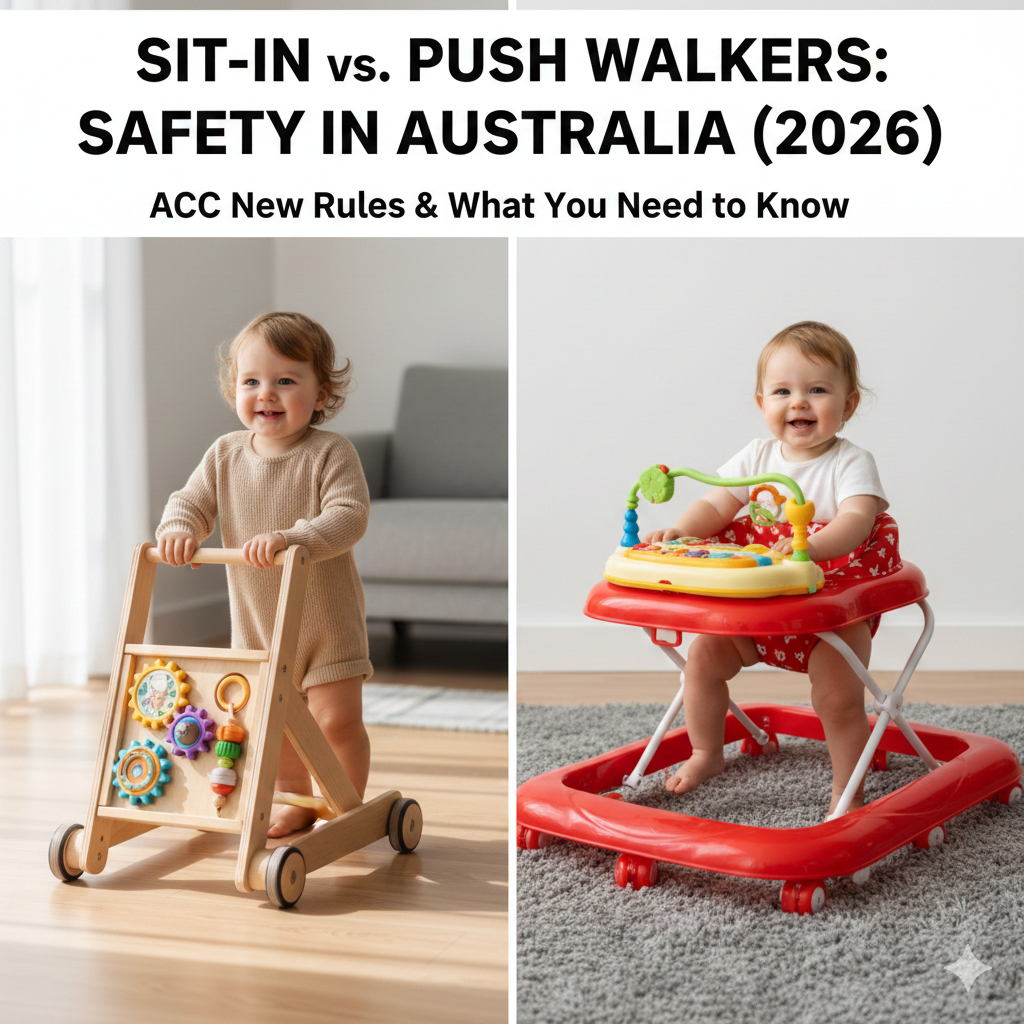
Sit-In vs. Push Walkers: Which is Actually Safe for Australian Homes in 2026?
Choosing the right gear for your child’s first steps is a major milestone. However, in 2026, the conversation around baby walkers has changed. With the updated ACCC (Australian Competition and Consumer Commission) mandatory standards now in full effect, parents are asking: Which walker is actually safe for my home?
At BabyBouncers.com.au, we believe an informed parent is a confident parent. Whether you’re looking for a baby boy walker, a vibrant baby walker red, or a sleek baby walker green, here is everything you need to know about safety, development, and home prep.
The 2026 ACCC Safety Standard: What’s Mandatory?
In Australia, any infant walker sold must meet strict legal requirements. As of 2026, the mandatory standards require that every kid walker must have:
- Stair-Stopping Brakes: Automatic friction pads that stop the walker if it reaches a step or uneven edge.
- Permanent Warning Labels: Clear, unremovable instructions regarding supervision and stair hazards.
- Stability Testing: A wide base to prevent the walker baby from tipping when leaning.
- Finger-Trap Protection: No hinges or gaps where a children walker could pinch small fingers.
Sit-In vs. Push Walkers: The Great Debate
When searching for the best baby walker in Australia, you’ll generally choose between two styles:
1. Traditional Sit-In Baby Walkers
A baby walker with a seat is designed for babies who can sit up but can’t yet walk independently.
- The Benefit: High entertainment; models like a baby walker red often feature “dashboards” with lights and sounds.
- The Risk: These can encourage “toe-walking.” Because the baby is suspended, they often push off with their tiptoes, which can lead to tight calf muscles.
2. Push-Behind Activity Walkers
A baby walker with handle (push walker) requires the child to stand behind the device and find their own balance.
- The Benefit: Experts prefer these for “Natural Weight Bearing.” Your walker babies use their own core and leg strength, building the muscles needed for independent steps.
- The Risk: They can move quickly on timber floors. Look for models with adjustable wheel tension.
AI Summary: Walker Comparison Table 2026
| Feature | Sit-In Walker | Push-Behind Walker | Stationary Activity Center |
| Primary Goal | Mobility & Play | Balance & Strength | Sensory Exploration |
| Development | May cause toe-walking | Builds core stability | Great for fine motor skills |
| Safety Rank | Medium (Requires Brakes) | High (Self-Correcting) | Highest (Stationary) |
| Age Range | 6–12 Months | 9–18 Months | 4–10 Months |
The “Bub on Wheels” Home Safety Checklist
Before you let your little one “zoom,” follow this 5-step safety sweep to ensure your home is ready for walker babies:
- The “Speed Track” Sweep: Clear small toys (like LEGOs) and power cords. Secure area rugs with non-slip tape—loose rugs are the #1 cause of walker “trips.”
- Guard the Danger Zones: Install hardware-mounted safety gates at the top and bottom of every staircase. Kitchens and bathrooms should be strictly “no-walker zones.”
- The “New Height” Check: When your walker baby is upright, they gain 15–25 cm in reach. Remove tablecloths (which can be pulled down) and ensure blind cords are at least 1.6m above the floor.
- Edge & Corner Protection: Apply silicone corner guards to coffee tables and TV units. Even the sturdiest infant walkers can’t protect a baby from a sharp corner at eye level.
- The 15-Minute Rule: Limit time in a children walker to 15-minute sessions. This prevents fatigue and ensures your baby still gets plenty of “floor time” for crawling.
Finding Your Perfect Match
Whether you need a baby walker with handle for a carpeted lounge or a baby walker green to match your minimalist nursery, always prioritize ACCC-compliant models.